

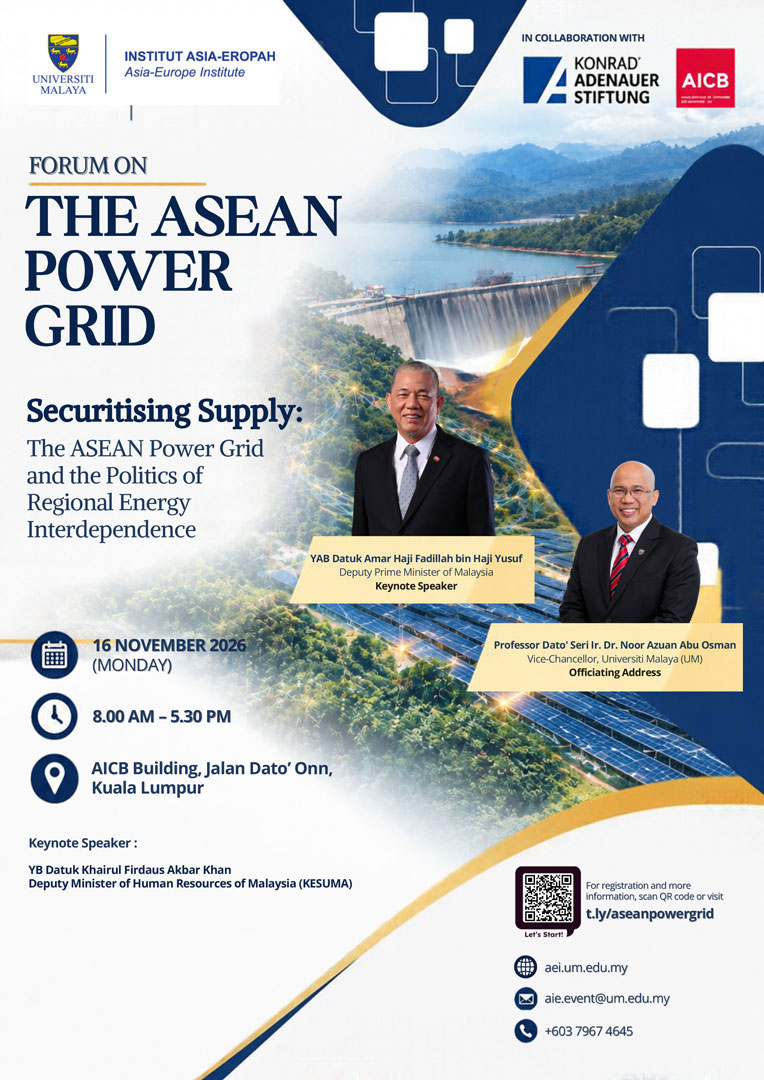
Forum on
Date: 16th November 2026 (Monday)
Time: 8:00 am - 5:00 pm
Venue: AICB Building, Jalan Dato' Onn, Kuala Lumpur
Registration: Click here for online registration form
The blockage of shipping through the Strait of Hormuz in 2026 forced energy policy makers in Southeast Asia to confront realities that had hitherto been the concern of the economic planners and utility managers. How best to get adequate energy supplies for their countries to sustain economic growth became an issue of national and regional security. At the 48th ASEAN Summit, Prime Minister Anwar Ibrahim said that energy security, food resilience, and stable supply chain and regional connectivity have become “strategic imperatives”. “Previously, they were sectoral concerns” (Anwar Ibrahim, 2026). In April 2026, ASEAN energy ministers met in a special session. In October of the same year, the 44th ASEAN Ministers on Energy Meeting (AMEM) placed the ASEAN Framework Agreement on Petroleum Security at the core of the region’s preparedness (44th AMEM, 2026). In the process, the ASEAN Power Grid (APG) got a new mission. First mooted in 1999 as part of the ASEAN Plan of Action for Energy Cooperation to move electricity from surplus to deficit areas (Aris & Jørgensen, 2020), the APG has now been redefined as a major initiative on energy security. Framing the APG as a means to achieve regional energy security and counter the region’s fuel import dependence facilitates the acceptance of costs and constraints that members states had hitherto been reluctant to accept (44th AMEM, 2026; Kao, 2026). A number of recent events have renewed interest in the grid. The launch of the APG Financing Initiative has brought together the Asian Development Bank, the World Bank, the ASEAN Secretariat, and the ASEAN Centre for Energy (ASEAN Ministerial Interface Meeting 2025). The rapid growth in demand for electricity in Malaysia, especially from data centres, has also been reported (Chai, 2026). Other external actors have begun to link their energy cooperation to infrastructure partnerships, bringing the grid into larger regional power competition (Landau, 2026). The main issues related to the construction of the grid have not changed. There are differences in national regulations. ASEAN member states have not reached agreements on fair conditions for energy trade. Large projects struggle to secure financing, and there are rules yet to be established regarding the laying of submarine cables. Singapore’s Foreign Minister stated, ‘The challenge is execution’ (Balakrishnan, 2026). These challenges, as well as the issues addressed in the ASEAN Way, require ASEAN member states to compromise and surrender some of their sovereignty. This forum aims to answer what will make the region’s recent heightened sense of vulnerability a catalyst for regional cooperation? It aims to identify the key constraints for the development of the grid and key constraints for the governance of the grid. Lastly, it aims to analyze the impact of the energy crisis of 2026 on the region and whether it will renew states’ commitment to regional integration or cause member states to retreat to greater self-reliance.
| Time | Details |
|---|---|
| 0900 | Registration |
| 0920 | National Anthem (Negaraku), followed by prayer recital |
| 0930 | Welcome Speech by Prof. Emeritus Dr. Azirah Hashim, Executive Director of the Asia-Europe Institute (AEI), Universiti Malaya |
| 0940 | Panel Session 1: The Role of Academia, International Organisations, and Civil Society in Promoting Renewable Energy within the ASEAN Power Grid
|
| 1040 | Coffee Break (Participants) |
| 1100 | Panel Session 2: Powering Regional Connectivity: The Role of the Industry in Promoting Renewable Energy within the ASEAN Power Grid
|
| 1215 | Lunch break |
| 1400 | Arrival of VVIPs and Official Delegates |
| 1430 | Officiating Address by Professor Dato’ Seri Ir. Dr. Noor Azuan Bin Abu Osman, Vice-Chancellor of Universiti Malaya |
| 1445 | Keynote address by YAB Datuk Amar Haji Fadillah Bin Haji Yusof, Deputy Prime Minister of Malaysia and the Minister of Energy Transition and Water Transformation (PETRA) Title: Powering Regional Integration PETRA’s Strategic Role in ASEAN Power Grid |
| 1500 | Keynote address by YB Datuk Khairul Firdaus Akbar Khan, Deputy Minister of Human Resources of Malaysia Title: The Role of the Ministry of Human Resources in Developing Human Capital for the ASEAN Power Grid |
| 1515 | Closing Remarks by Ms Natalie Russmann, Country Director, Konrad-Adenauer-Stiftung |
| 1530 | Presentation of Monograph titled Wired for Security: The Geopolitics of the ASEAN Power Grid |
| 1600 | Group Photo |
| 1620 | End of Programme |
Last Update: 14/11/2026