


Book Seminar on ASEAN Regionalism and Security
The Association of Southeast Asian Nations (ASEAN) has developed multiple institutional frameworks to engage both China and the United States, addressing interconnected economic and security concerns through what scholars term a regional security complex. This complex incorporates both realist calculations of power balances and constructivist emphasis on normative dialogue, representing a distinct Southeast Asian approach to regional order.
The contemporary ASEAN security architecture emerges from the historical tension between universalism and regionalism that was crystallized during the 1945 San Francisco Conference. While delegates acknowledged the primacy of the United Nations alongside legitimate roles for regional arrangements in dispute settlement, the subsequent Cold War systematically undermined both the UN Security Council and regional organizations through bipolar competition. Today, the UN confronts dual pressures of expanding peacekeeping obligations and declining Official Development Assistance (United Nations, 2025), creating space for regional solutions.
ASEAN's institutional DNA reflects foundational principles that simultaneously enable and constrain its security role. The concept of ASEAN Centrality - positioning ASEAN as the primary vehicle for regional collective action - remains aspirational rather than fully realized, constrained by binding principles of musyawarah (consultation and consensus) and non-interference codified in the Zone of Peace, Freedom and Neutrality Declaration (ZOPFAN, 1971) and the Treaty of Amity and Cooperation (TAC, 1976). Significantly, both the United States (2009) and China (2003) have acceded to the TAC, formally acknowledging these normative frameworks while pursuing their strategic interests.
Initially conceived as an economic organization, ASEAN underwent critical institutional evolution by formally incorporating security considerations during the Fourth ASEAN Summit in 1992. This transformation produced layered security mechanisms operating at different levels of engagement. The ASEAN Regional Forum (ARF, established 1994) provides the broadest platform for security dialogue, while the East Asia Summit (EAS, initiated 2005) and the ASEAN Defence Ministers Meeting Plus (ADMM-Plus, launched 2010) offer more focused venues for addressing collective security challenges. The ASEAN Plus Three framework (APT, formed 1997), though primarily economic, contributes to what scholars characterize as "ASEAN+" institutional architecture - a complex web facilitating member states' engagement with multiple dialogue partners while maintaining strategic autonomy amid intensifying Sino-American competition.
This institutional complexity reflects ASEAN as a vehicle for dialogue with multiple major powers, avoiding rigid alignment while maximizing engagement opportunities. However, the effectiveness of this approach faces mounting pressure as great power competition intensifies, particularly in maritime domains where sovereignty disputes intersect with strategic rivalry.
To examine these evolving dynamics, three distinguished scholars will provide critical analysis. Professor Dr. Bilveer Singh from the National University of Singapore will offer comprehensive examination of ASEAN regional security, analyzing both emerging threats and strategic opportunities within the current geopolitical context. Professor Dr. Lai Yew Meng will investigate the resilience of ASEAN centrality against the proliferation of minilateral security arrangements that potentially bypass traditional ASEAN mechanisms. Associate Professor Dr. Ramli Dollah will analyze trilateral cooperation in the Sulu-Celebes Seas, a maritime domain where transnational security threats - including violent extremism and maritime piracy - test ASEAN's collective response capacity. The ASEAN security architecture thus presents a paradox of institutional abundance amid operational scarcity. While multiple forums provide diplomatic flexibility and normative coherence, their effectiveness ultimately depends on member states' political will to transcend narrow sovereignty concerns - a challenge magnified by intensifying great power competition and emerging non-traditional security threats.
 Prof. Dr. Bilveer Singh is a prominent scholar of Southeast Asian politics and security, currently serving as Deputy Head of the Department of Political Science at the National University of Singapore (NUS). A Singapore citizen, he holds advanced degrees in International Relations from the Australian National University and maintains adjunct appointments across Indonesia, Malaysia, and Singapore.
A leading expert on ASEAN security, Islamist extremism, great power dynamics, and Singapore politics, Prof. Bilveer has authored numerous influential books and articles that shape regional discourse. His contributions extend to editorial boards of major academic journals and regional research networks, including long-standing roles in the Southeast Asian Conflict Studies Network.
A recipient of multiple teaching excellence awards at NUS, he continues to influence scholarship, policy discussions, and public understanding of Southeast Asia’s evolving political and security landscape.
 Assoc. Prof. Dr. Lai Yew Meng is an Associate Professor of Politics and International Relations at Universiti Malaysia Sabah (UMS) and the former Dean of the Centre for the Promotion of Knowledge and Language Learning. He currently serves as Deputy Dean and leads the Maritime Security and Sovereignty Cluster at the UMS Centre for Blue Economy and Maritime Security Research.
A graduate of the University of Warwick, with research appointments at the Japan Institute of International Affairs and Keio University, he specialises in Japanese and Chinese foreign policy, Sino-Japanese relations, East Asian security, Malaysian politics, and South China Sea geopolitics. His scholarly work is widely published by leading local and international publishers.
Dr. Lai has also served on Malaysia’s National Consultative Council on Foreign Policy and has contributed to diplomatic training programmes abroad, establishing him as a respected scholar and contributor to regional security and foreign policy studies.
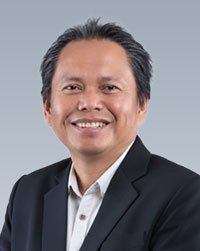 Assoc. Prof. Dr. Ramli Dollah is an Associate Professor in the International Relations Programme at the Faculty of Social Sciences and Humanities, Universiti Malaysia Sabah (UMS). His expertise spans security studies, border management in Sabah, migration, and peace and security in East Asia. He earned his PhD from Universiti Utara Malaysia in 2018.
He has authored and edited numerous books on migration, Sabah security, and Malaysia–Indonesia relations, and has published extensively in national and international journals such as Scientific Reports, Plos One, East Asia, and the Journal of International Migration and Integration. His research covers border challenges, radicalisation, security governance, and foreign policy.
Actively engaged in multiple research initiatives, Assoc. Prof. Dr. Ramli Dollah is regarded as one of Malaysia’s leading scholars on Sabah’s security environment and regional border issues.
| 8:30 AM | Registration of Participants / Breakfast |
| 9:15 AM | Welcome Remarks by Distinguished Professor Dato' Dr. Rajah Rasiah, Executive Director, Asia-Europe Institute (AEI) |
| 9:30 AM | Keynote Session: ASEAN Regionalism, Threats and Opportunities Prof. Dr. Bilveer Singh National University of Singapore |
| 10:30 AM | Morning Refreshments |
| 10:45 AM | Session 1: Securitizing Non-Traditional Threats & The Trilateral Cooperation Arrangement in The Sulu-Celebes Seas Assoc. Prof. Dr. Ramli Dollah Universiti Malaysia Sabah |
| 12:15 PM | Lunch Break |
| 2:00 PM | Session 2: ASEAN Centrality and the Rise of Minilateralist Approaches in Regional Security: A Malaysian Perspective Assoc. Prof. Dr. Lai Yew Meng Universiti Malaysia Sabah |
| 3:30 PM | Open Discussion and Q&A |
| 4:00 PM | Day 1 Closing Remarks by Dr Kevin Fernandez, Deputy Executive Director (Development, Research, Innovation, and Internationalization), AEI |
| 4:15 PM | End of Day 1 |
| 8:30 AM | Breakfast |
| 9.00 AM | Recap of Day 1 and Overview of Day 2 |
| 9:15 AM | Book Seminar: ASEAN Centrality moderated by Dr Kevin Fernandez, Deputy Executive Director (Development, Research, Innovation, and Internationalization), AEI |
| 10:30 AM | Morning Refreshments |
| 10:45 AM | Panel Discussion: Navigating the Securitization of Sabah Speakers: Prof. Dr. Bilveer Singh, Assoc. Prof. Dr. Lai Yew Meng, and Assoc. Prof. Dr. Ramli Dollah |
| 12:15 PM | Lunch Break |
| 2:00 PM | Roundtable Discussion: ASEAN Regionalism and Security – Future Directions |
| 3.30 PM | Closing Session |
| 4.00 PM | Photo session |
| 4:15 PM | End of Programme |
Last Update: 15/12/2025